


Phone:
+86-138-0577-0261


Views: 0 Author: Site Editor Publish Time: 2026-09-19 Origin: Site


Polyethylene Terephthalate (PET) meat packaging presents a massive challenge for procurement and packaging engineering teams. You have to balance strict shelf-life requirements, material performance, and aggressive sustainability mandates. While PET carries the Resin Identification Code #1 and is theoretically highly recyclable, putting it to work in fresh food environments changes the equation entirely. Biological contamination, multi-layer barrier films, and carbon black pigments introduce complex variables that frequently render standard meat packaging unrecyclable in municipal streams. We see these items constantly diverted to landfills or incinerators because they fail at the sorting or washing stages. This technical evaluation breaks down the structural, chemical, and infrastructural realities of recycling PET packaging. We provide a concrete framework to evaluate whether specific designs meet true end-of-life recyclability standards, ensuring you comply with emerging environmental legislation without compromising food safety or product integrity.
Polyethylene Terephthalate dominates the food packaging sector due to its exceptional physical properties. It offers high clarity, excellent moisture barrier characteristics, and robust mechanical strength. These attributes protect perishable goods from physical damage while providing the visual transparency consumers demand on the retail shelf. The global recycling infrastructure was built primarily around PET beverage bottles. Facilities utilize sophisticated sorting, grinding, washing, and extrusion technologies to convert post-consumer bottles into high-grade recycled flakes.
Thermoformed PET technically fits into this existing stream because it shares the same base polymer chemistry. However, a significant gap exists between theoretical recyclability in a controlled laboratory environment and practical recyclability within the chaotic realities of curbside collection. On the production floor, PET provides several distinct advantages that make it difficult to replace:
The specific use-case of the packaging drastically alters its journey through a recovery facility. Dry applications present minimal challenges. In contrast, high-moisture and high-protein applications introduce severe contamination risks. When evaluating a supermarket fresh tray designed for raw poultry or beef, the presence of residual organic matter complicates the washing phase. The manufacturing process itself also changes the material's behavior.
Thermoforming requires PET with a different intrinsic viscosity (IV) compared to blow-molded bottles. Thermoformed trays are inherently more brittle. They generate more fines, or plastic dust, during the mechanical shredding process at the MRF. When these thermoformed flakes mix with bottle flakes in the extrusion melt, they can alter the melt flow index. This slightly degrades the quality of the resulting secondary market bales, making recyclers hesitant to accept high volumes of thermoforms mixed with their premium bottle streams.
Historically, the packaging industry relied heavily on bottle-grade rPET to manufacture new thermoformed trays. The supply of recycled bottles is finite. The beverage industry increasingly demands its own material back for closed-loop bottle-to-bottle recycling. This dynamic forces tray manufacturers to develop independent recovery streams. The technological shift toward closed-loop "tray-to-tray" recycling facilities is currently underway.
These specialized plants are engineered specifically to handle the unique melt viscosities, label adhesives, and contamination profiles of thermoformed packaging. By isolating trays from bottles, these facilities prevent cross-contamination and maintain the specific polymer characteristics required for continuous thermoforming cycles.
| Material Property | Bottle-Grade PET Stream | Thermoform-Grade PET Stream |
|---|---|---|
| Intrinsic Viscosity (IV) | High (0.75 - 0.85 dL/g) | Lower (0.60 - 0.70 dL/g) |
| Fines Generation During Shredding | Low | High (due to brittleness) |
| Primary Contaminants | Sugars, water-soluble liquids | Proteins, fats, complex adhesives |
| Wash Temperature Tolerance | High (up to 85°C) | Moderate (trays may deform at high heat) |
Raw meat packaging presents a unique chemical challenge. Animal fats and proteins adhere aggressively to PET surfaces. Standard Material Recovery Facilities utilize cold-wash or mild hot-wash processes designed to remove dirt and water-soluble beverage residues. These systems lack the aggressive caustic chemicals and high temperatures necessary to strip heavy biological loads from plastic surfaces.
If heavily soiled trays enter the recycling stream, the residual lipids saponify in the wash water. This creates a soapy sludge that ruins the water chemistry and coats the clean plastic flakes. During the high-heat extrusion phase, these residual fats burn, causing severe discoloration and structural weakness in the recycled resin. Consequently, optical sorters and manual quality control personnel are trained to divert visibly soiled meat trays directly to landfill or incineration streams to protect the integrity of high-grade rPET bales.
Modern recycling facilities rely on Near-Infrared (NIR) optical sorting technology to identify and separate different polymer types at high speeds. When NIR light hits a plastic item, the polymer reflects a specific wavelength signature back to the sensor. The computer identifies the signature and fires a targeted burst of air to blow the item into the correct bunker.
Traditional meat packaging heavily utilizes carbon black pigment for aesthetic purposes, as it masks blood and purge. Carbon black absorbs NIR light completely. The sensor receives no reflection, causing the system to misidentify the tray or miss it entirely. The item inevitably ends up in the residual waste stream. While newer detectable black pigments exist, they carry significant cost premiums. Adoption rates remain low, and many local MRFs still lack the updated software libraries required to recognize these alternative pigments accurately.
Extending the shelf life of fresh meat requires strict control over oxygen transmission rates. Standard PET provides an adequate moisture barrier but allows too much oxygen permeation for highly sensitive proteins. Manufacturers solve this by co-extruding or laminating PET with oxygen barrier layers, most commonly Ethylene Vinyl Alcohol (EVOH) or Polyethylene (PE). These laminated structures severely disrupt the mechanical recycling process.
Evaluating ultrasonic sealing technologies offers a viable alternative to traditional chemical adhesives. This approach potentially improves end-of-life recyclability by eliminating adhesive residues entirely, allowing the lidding film to separate cleanly from the tray flange.
Transitioning packaging lines requires assessing the physical performance trade-offs between virgin polymers and recycled alternatives. Virgin PET offers flawless clarity, maximum structural integrity, and predictable thermoforming behavior. Post-Consumer Recycled (rPET) introduces slight variations based on the purity of the bale and the number of heat histories the polymer has endured.
Depending on the source material, rPET can exhibit a slight yellow or grey tint. It is also marginally more brittle, requiring careful engineering of the tray's ribbing and flange structures to prevent cracking during transit. The supply chain for high-quality, food-grade rPET is subject to regional availability and fluctuating collection rates, requiring robust procurement strategies to ensure consistent volume.
| Performance Metric | Virgin PET | Post-Consumer rPET |
|---|---|---|
| Optical Clarity | Exceptional (Crystal Clear) | Variable (Slight tint possible) |
| Impact Resistance | High | Moderate (Requires structural ribbing) |
| Supply Chain Stability | Highly Stable | Subject to regional collection rates |
| Regulatory Compliance | Standard Food Grade | Requires strict EFSA/FDA certification |
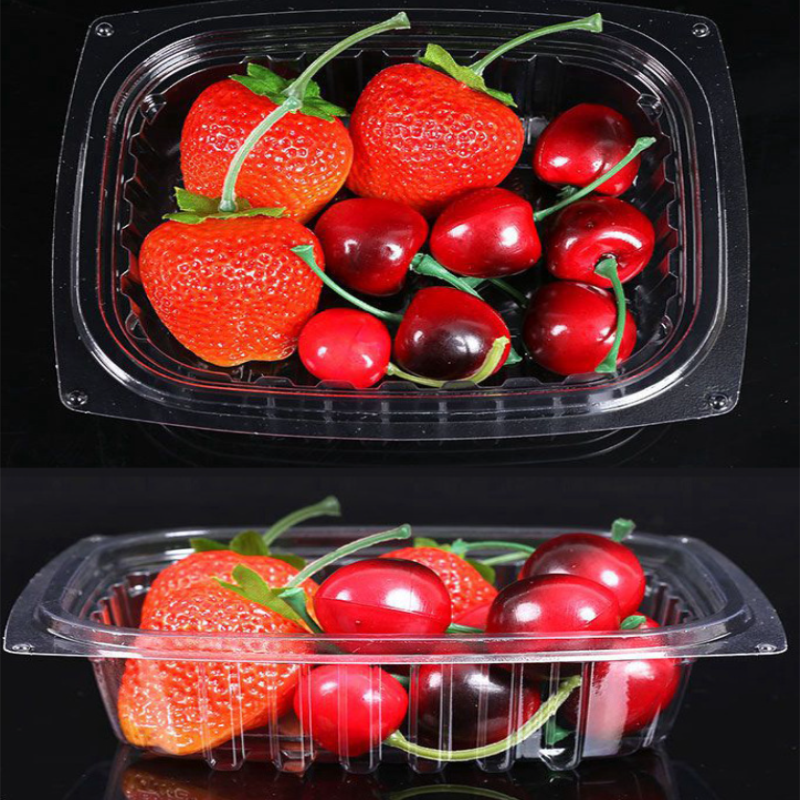
Analyzing how PET performs across different food categories provides insight into optimal recycling conditions. The produce sector demonstrates the highest success rate for closed-loop recovery. A mono-material recyclable PET fruit tray generates virtually zero biological contamination. Without the need for heavy oxygen barriers or absorbent pads, these trays flow seamlessly through standard MRF wash processes.
The food service sector faces entirely different challenges. When evaluating a food delivery tray, temperature resistance is the primary metric. Standard Amorphous PET (APET) deforms under high heat. To withstand microwave or oven heating, manufacturers use Crystallized PET (CPET). The crystallization process alters the polymer structure, making it opaque and highly heat-resistant. This different melting point means CPET acts as a contaminant in standard APET recycling streams and is routinely rejected by reprocessors.
When comparing PET to alternative materials, the limitations of substitutes become apparent. Polypropylene (PP) offers higher heat resistance but lower clarity, making it less appealing for retail display. Expanded Polystyrene (EPS) is facing global phase-outs due to severe environmental persistence and fragmentation issues. Molded pulp and compostable fibers struggle with moisture vapor transmission, requiring synthetic chemical coatings that ultimately negate their compostability.
Achieving true circularity requires engineering packaging specifically for the recovery infrastructure. Procurement teams must mandate strict Design for Recyclability (DfR) guidelines when sourcing any plastic tray for fresh food applications. Color selection is paramount. Mandating clear or light-blue transparent PET ensures maximum compatibility with optical sorters and guarantees the highest secondary market value for the resulting flakes.
Mono-material construction is equally critical. Multi-layer laminates must be eliminated. If barrier properties are necessary, manufacturers should utilize high-barrier mono-PET solutions or compatible micro-coatings, such as silicon oxide (SiOx). These ultra-thin coatings wash off easily in the friction washer without contaminating the polymer matrix. Labeling specifications must require water-soluble adhesives and compatible substrate materials, like PP or PE, which naturally float during the density separation phase while the heavier PET sinks.
The traditional absorbent pad, typically constructed from a mix of cellulose and super-absorbent polymers glued to the base of the tray, guarantees the packaging will be rejected by recyclers. Consumers rarely remove these pads before disposal, introducing severe mixed-material contamination into the PET stream. Procurement strategies must pivot toward pad-less tray designs.
These structural innovations utilize honeycomb bases, micro-channel capillary structures, or false bottoms to trap and isolate purge without introducing mixed materials. Capillary action uses surface tension to pull liquids into tight channels, keeping the meat dry while maintaining a 100% mono-material structure. Additionally, lidding films must be engineered for clean separation. Peelable films must leave zero adhesive residue on the tray flange, ensuring the rigid PET base remains uncontaminated.
Internal engineering efforts must align with recognized external standards. Packaging designs should be validated against the Association of Plastic Recyclers (APR) Design Guide in North America or RecyClass standards in the European Union. These frameworks provide empirical testing protocols to prove a package will not disrupt the recycling stream.
Consumer behavior remains a massive variable in the recovery equation. Utilizing standardized on-pack messaging, such as the How2Recycle label system, provides explicit instructions. Educating consumers to rinse the tray and discard the lidding film directly reduces MRF contamination rates and increases the yield of usable material.
The regulatory landscape governing packaging waste is shifting rapidly from voluntary targets to mandatory financial penalties. Extended Producer Responsibility (EPR) laws, already mature in the EU and UK and rapidly emerging across US states, shift the financial burden of municipal waste management onto the producers of the packaging. These frameworks utilize eco-modulation fees.
Packaging that is difficult to recycle, such as black PET, multi-layer laminates, or EPS, incurs significantly higher tax rates per ton placed on the market. Conversely, clear, mono-material designs that meet strict DfR criteria qualify for lower fee tiers. Procurement teams must integrate these regulatory penalties into their material selection matrices, as the financial impact of non-compliance will quickly outpace the initial unit cost savings of using cheaper, non-recyclable materials.
Marketing a product as sustainable carries immense legal and reputational risk if the claims cannot be substantiated. Labeling a traditional meat tray as "100% Recyclable" constitutes greenwashing if local infrastructure cannot actually process it due to biological contamination, carbon black pigment, or glued-in pads. Regulatory bodies strictly enforce marketing claims.
The Federal Trade Commission (FTC) Green Guides stipulate that marketers cannot make unqualified recyclable claims unless recycling facilities are available to a substantial majority of consumers or communities where the item is sold. The FTC defines a substantial majority as at least 60%. If a tray is routinely rejected by MRFs due to its design, claiming recyclability violates these guidelines, exposing the brand to litigation and consumer backlash.
Transitioning an entire product line to sustainable packaging requires rigorous supply chain assessment. Suppliers must demonstrate the capacity to deliver clear, mono-material, pad-less PET trays at scale without compromising lead times. The transition period requires careful management and significant tooling investments, as pad-less designs require highly precise thermoforming molds.
Packaging engineers must conduct extensive shelf-life validation trials to ensure mono-PET solutions perform equally to legacy multi-layer barriers. Transportation durability must be re-tested, particularly if shifting to rPET blends. Brands must manage consumer aesthetic acceptance. Removing carbon black and absorbent pads means consumers will see the natural purge of the meat. This requires proactive marketing and transparency to educate buyers on why the packaging looks different and how it benefits the environment.
A: Yes, heavy biological contamination from blood and fat can cause recycling facilities to reject the material. Trays must be rinsed clean by the consumer, which is a significant behavioral barrier.
A: Traditional black plastic uses carbon black pigment, which absorbs the Near-Infrared (NIR) light used by optical sorters in recycling plants, causing the trays to go undetected and end up in landfills.
A: It depends on the type of PET. Standard APET (used for cold food) is widely recyclable. CPET (crystallized PET, used for hot food/microwaveable trays) has a different melting point and is often rejected by standard PET recycling streams.
A: Fruit trays are typically clear, mono-material, and free of heavy biological contaminants, making them highly desirable for recyclers. Meat trays often utilize unrecyclable black pigments, multi-layer oxygen barriers, and glued-in absorbent pads.
A: Yes. The lidding film is typically made from a different polymer (like polyethylene) and uses adhesives that contaminate the PET recycling stream. It must be completely removed and discarded separately.
A: No. Absorbent pads are made from a mixture of cellulose and super-absorbent polymers. They cannot be recycled and will contaminate the plastic stream if left attached to the tray during disposal.


