


Phone:
+86-138-0577-0261


Views: 0 Author: Site Editor Publish Time: 2026-07-19 Origin: Site


Transit damage is rarely an inevitable cost of doing business. You should view it as a completely solvable failure in your packaging architecture. When shipments arrive broken, the compounded costs pile up rapidly across your operation. You lose expensive replacement inventory, pay high return shipping fees, and suffer diminished customer lifetime value. Standard loose dunnage like bubble wrap, packing peanuts, and air pillows often fail because they shift unpredictably during rough transit. In contrast, engineered structural packaging holds delicate items securely in place from origin to destination.
A custom divider box replaces unpredictable void fill with precise spatial control. This highly engineered approach significantly reduces shock and vibration damage across complex modern supply chains. However, evaluating the actual return on investment requires analyzing your specific material selection, diverse transit environments, and overall product fragility. You will learn exactly how precise spatial control neutralizes dangerous impact forces. We will also explore advanced material options and show you how engineered partitions drastically streamline fulfillment operations.
We must first understand how products actually break inside a sealed box. Single-point impacts transfer intense energy directly through standard loose packaging. When a parcel sorting machine drops a box three feet onto concrete, loose void fill compresses unevenly. This rapid compression allows the full kinetic force to hit your fragile item directly. Conversely, structured internal grids distribute drop forces evenly across the broad exterior walls of the box. The internal grid acts as a rigid shock absorber, redirecting dangerous energy away from the payload.
Next, we must consider the invisible threat of vibration and harmonics. Truck transit and air cargo generate persistent, high-frequency micro-movements. These constant vibrations travel directly through the master carton during long-haul journeys. Un-compartmentalized products constantly rub against each other or vibrate against rough box walls. Because of this friction, they suffer from severe surface abrasion and ruinous label scuffing. Structural grids stop this movement by locking the product tightly in place.
Finally, warehouse storage and transit stacking introduce severe compression and stacking fatigue. Heavy loads press down on lower boxes for days or weeks in humid distribution centers. Without internal support, outer boxes often buckle or crush under the intense top-down weight. Vertical partitions act as strong internal load-bearing columns. They push back against this vertical pressure aggressively. This structural reinforcement increases the overall Edge Crush Test (ECT) performance of your master carton. It prevents the outer packaging from collapsing entirely under heavy warehouse loads.
Precise packaging engineering directly neutralizes the most common shipping hazards. You can eliminate the volatile "void space" variable entirely. Custom die-cut compartments hold products in a fixed, suspended orientation. When items cannot shift loosely inside the box, the exact drop orientation becomes largely irrelevant. The carton can fall violently on its side, flat base, or sharp corner. Regardless of the impact angle, the payload remains suspended safely away from the dangerous crush zone.
Part-to-part isolation serves as another critical defense mechanism. Internal collisions cause the vast majority of invisible damage in multi-item shipments. Glass bottles, fragile cosmetics, and sensitive electronic components frequently shatter against one another during transit. A structured partition physically blocks these individual items from ever meeting. They simply cannot touch, scratch, or shatter against neighboring pieces. This isolation is absolutely crucial for shipping multiple fragile units in a single master carton.
Furthermore, engineered partitions create highly predictable fulfillment standard operating procedures (SOPs). Warehouse packers no longer need to guess how much bubble wrap to use. They execute a standardized, repeatable drop-and-seal process every single time. This consistency removes dangerous human error from your fast-paced packing lines. Seasonal or temporary workers can pack items perfectly with minimal training.
Best Practice: Do not use loosely fitted grids. Always ensure the partition slides tightly against the inner walls of the master carton to prevent shifting.
Choosing the right material ensures maximum physical protection and operational cost efficiency. You must match the structural material directly to your product's specific fragility profile and transit environment.
First, corrugated and kraft paper grids work exceptionally well for dry goods. They easily protect standard consumer packaged goods (CPG) and handle budget-conscious bulk shipping requirements. You can specify different flute sizes (like B-flute or E-flute) depending on the needed rigidity. However, they carry distinct limitations. Corrugated board generates fine paper dust during transit friction. It can also weaken significantly if exposed to high humidity or severe temperature fluctuations.
Second, PET divider packaging and rigid plastics serve demanding, high-end applications. They perform beautifully in sterile cleanroom environments or medical supply chains. Liquid-heavy cosmetics and polished products requiring scuff-free transit benefit greatly from plastics. A custom plastic divider box offers superior bending rigidity. It sheds zero particulates onto your product and provides excellent moisture resistance. If a liquid bottle leaks, the plastic grid will not absorb the spill and collapse like paper would.
Lastly, hybrid and thermoformed solutions handle highly complex or unusual geometries. You can integrate molded soft inserts tightly with rigid structural grids. This advanced hybrid approach secures highly fragile items safely, absorbing multi-axis shocks perfectly.
| Material Type | Best Industry Use Case | Key Structural Advantage | Primary Limitation |
|---|---|---|---|
| Corrugated / Kraft | Dry goods, Budget bulk shipping | Very low unit cost, highly recyclable | Generates dust, weakens in high humidity |
| Rigid Plastic / PET | Cleanrooms, Liquids, Cosmetics | Zero particulate shedding, moisture proof | Requires higher upfront tooling investment |
| Hybrid Thermoformed | Complex, highly fragile geometries | Perfect contour matching and suspension | Longer engineering and design cycle |
Different industries face completely unique shipping hazards. A one-size-fits-all approach routinely fails in high-risk sectors.
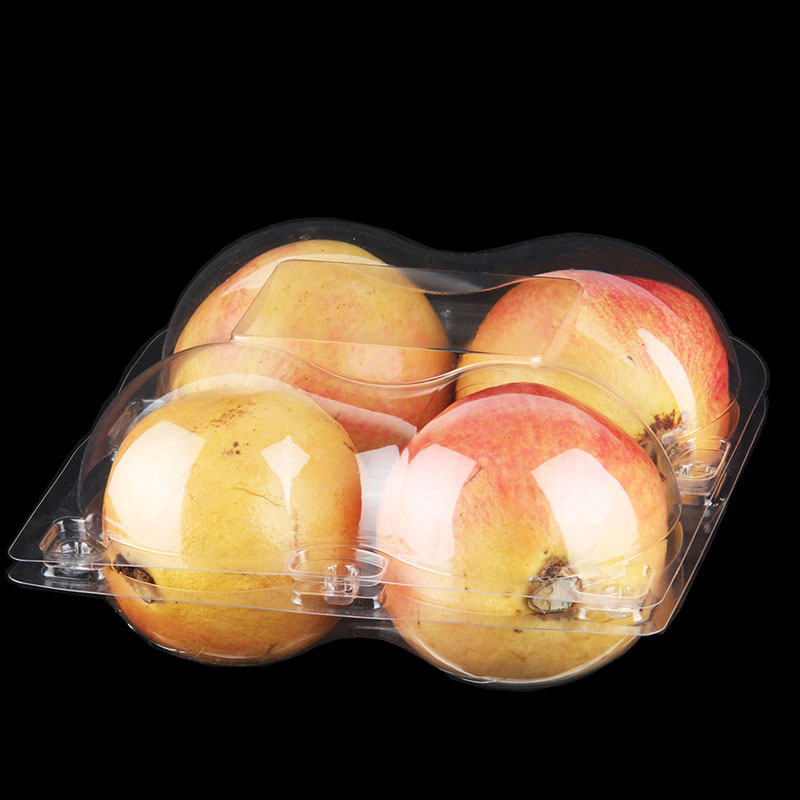
Agriculture and fresh produce supply chains encounter severe bruising and complex moisture control challenges. Soft fruits compress easily under their own weight during bumpy trailer rides. To solve this, commercial farmers use specialized structural packaging. For example, a 4 divider fruit box isolates high-value produce safely. It prevents delicate fruits from rubbing together and spreading rot. Alternatively, you might pack premium organic fruits in an apple shaped clamshell. You can integrate this exact molded container directly within a rigid outer carton. This powerful combination prevents skin abrasion, stops airflow restriction, and eliminates devastating crushing forces.
Cosmetics and pharmaceutical companies focus intensely on strict glass isolation. They must prevent label scuffing to maintain a flawless visual presentation for the end consumer. Unboxing aesthetics matter deeply to high-end cosmetic buyers sharing their purchases online. A rigid grid keeps heavy serum bottles perfectly separated. In the pharmaceutical sector, preventing glass-on-glass contact ensures critical medicines arrive intact without microscopic fractures.
Industrial components and heavy electronics require extreme heavy-duty segregation. Sharp metal machine parts easily pierce standard outer packaging, posing a danger to handlers. Structural partitions contain these heavy, sharp parts securely in individual cells. Furthermore, sensitive circuit boards demand specialized anti-static (ESD) materials. Specialized coated partitions safely dissipate static electricity while simultaneously preventing physical impact damage during warehouse handling.
You must evaluate the underlying business logic before comprehensively upgrading your packaging system. Upfront tooling costs often deter procurement teams initially. Die-cutting corrugated board or thermoforming specific plastics requires custom molds and steel cutting plates. However, you should strictly compare this initial setup fee against the significantly lowered unit cost at scale. Calculate exactly when your monthly shipping volume justifies the custom tooling. Typically, high-volume production runs rapidly absorb the initial setup fees, making the per-unit cost remarkably cheap.
Next, consider Dimensional (DIM) weight reduction strategies. Freight carriers charge heavily for oversized packages taking up truck space. Custom partitions cleanly eliminate the need for massive boxes packed full of excessive dunnage. By strategically shrinking the outer carton size, you directly lower your carrier shipping fees on every single order. Moving a box down just one dimensional pricing tier saves immense capital annually.
Labor efficiency also drives massive operational savings. You must factor in the hard cost of fulfillment time. Engineered partitions typically reduce manual packing time dramatically. Your warehouse team completely removes the tedious need to cut, tape, and wrap individual components. Dropping an item into a pre-made slot takes two seconds, whereas wrapping it securely in bubble wrap might take thirty seconds. Multiplied across thousands of orders, this efficiency reduces labor overhead significantly.
Finally, calculate the break-even logic regarding your specific damage rates. Weigh your current damage rate percentage directly against the new partition unit price. Add the average replacement cost of a broken product, plus the lost shipping fees. When the distinct financial savings from stopped breakages exceed the partition unit cost, the structural investment becomes immediately profitable.
Custom dividers fundamentally shift your entire packaging strategy. They transform packaging from a reactive, messy consumable into a proactive, engineered asset. By utilizing structured compartments, you gain precise control over drop shocks and internal transit vibrations. Right-sized packaging inserts streamline your entire fulfillment operation, cut tedious labor times, and drastically lower your carrier dimensional weight fees.
As an actionable next step, advise your packaging engineers to conduct a rigorous drop-test audit. Evaluate your current multi-pack shipments to establish a strict baseline failure rate. Drop your existing packed boxes from standard transit heights onto hard concrete. Document exactly where and how the internal contents break. Once you have this clear baseline data, request custom partition prototypes from your supplier to immediately measure the performance improvement.
A: A realistic baseline depends heavily on your specific tooling needs. Production runs under a few hundred units rarely justify the initial die and plate costs. However, order volumes exceeding 1,000 units usually see a rapid return on investment. High-volume runs efficiently absorb the upfront tooling fees, making the precise per-unit cost highly competitive against standard loose void fill.
A: Yes, it is highly sustainable. PET is widely accepted in most standard municipal recycling streams. It offers excellent environmental performance compared to mixed-material dunnage or non-recyclable single-use foams. Many modern sorting facilities process rigid PET easily, allowing your company to maintain strong sustainability compliance while still providing superior structural protection for delicate shipments.
A: The standard timeframe typically spans two to four weeks. Initial CAD design usually takes a few business days. After you approve the digital model, creating a physical prototype requires another week. Once you test and approve the physical sample, final production runs commence quickly. This careful timeline ensures exact fitment before mass manufacturing begins.


