


Phone:
+86-138-0577-0261


Views: 0 Author: Site Editor Publish Time: 2026-09-12 Origin: Site


Uneven material distribution in thermoformed packaging introduces severe operational risks. When the base of a tray thins out beyond acceptable tolerances, it leads to structural failure during transit. Base thinning compromises gas barrier properties, causes failed lid mating on automated packaging lines, and drives scrap rates up. Solving this issue requires understanding the physics of the thermoforming process. Heating and stretching a flat thermoplastic sheet over a three-dimensional mold naturally causes the material to thin out at the deepest points of the draw, which is almost always the base.
Counteracting this natural stretching phenomenon demands precise engineering interventions. Achieving a perfectly uniform base in a plastic tray requires a highly synchronized approach. You must align mold design, advanced process controls, and precise material selection to manipulate how the plastic flows. By controlling the stretch before the material locks into its final shape, manufacturers maintain structural integrity and eliminate downstream packaging failures.
Defining uniformity in commercial thermoforming requires establishing clear success criteria. For most packaging applications, maintaining base thickness tolerances within ±10% to ±15% of the target specification is the industry standard. Falling below this threshold compromises the load-bearing capacity. Achieving this tolerance requires mastering the physical forces acting on the heated polymer during the forming cycle. You cannot simply heat a sheet of plastic, pull a vacuum, and expect uniform thickness across a complex three-dimensional shape.
The draw ratio fundamentally dictates material stretch. This ratio compares the depth of the tray to its width and length. A shallow tray requires minimal material displacement. However, a deep-draw food delivery tray is significantly more susceptible to extreme base thinning. The deeper the cavity, the further the flat sheet must travel. You are spreading the exact same volume of plastic over a vastly larger surface area. When forming a multi-compartment tray, the webbing between compartments acts as a secondary draw, complicating the material distribution even further.
This dynamic creates the balloon effect. When you heat a thermoplastic sheet and apply a vacuum, it stretches similarly to an inflating balloon. As the vacuum pulls the sheet into the mold cavity, the plastic that touches the upper sidewalls of the mold cools instantly. This chilling effect locks that portion of the material into place. The remaining hot material, destined to form the base, is forced to stretch further and thinner to fill the bottom of the cavity. The corners and bottom edges are the last to form, making them the thinnest points in a standard negative draw.
Uneven base thickness directly destroys the functionality of mated parts. When the base is too thin, the entire tray loses its structural rigidity and begins to warp. This warping alters the dimensions of the tray lip and flange. Once the flange distorts, precise tolerances required for snap-on lids vanish. Automated film sealing machines fail to create a hermetic seal because the sealing head cannot apply even pressure against a warped, inconsistent flange. Tape sealing operations also suffer, as the distorted geometry prevents smooth adhesive application.
To troubleshoot base thinning physics on the factory floor, operators follow a strict diagnostic sequence:
Overcoming the physics of base thinning requires mechanical tooling solutions designed to manipulate material distribution actively. You cannot rely on vacuum alone for deep or complex draws. Engineers deploy specific mold design interventions to force plastic where it needs to go, ensuring the base retains enough material to meet structural requirements.
Plug-assist thermoforming is the primary defense against base thinning. Instead of letting the vacuum pull the sheet naturally, a mechanical plug descends into the heated sheet. It physically pushes the material into the mold cavity before any vacuum or pressure is applied. This action carries a thick mass of un-stretched plastic directly to the bottom of the mold. The timing of this downward stroke is calibrated in milliseconds to match the exact moment the plastic reaches its optimal forming temperature.
Plug material selection dictates the success of this process. If the plug is too cold or highly conductive, it will chill the plastic prematurely, causing webbing or tearing. If it is too hot, the plastic sticks to the plug and pulls back up during the return stroke.
Draft angles and corner radii play a massive role in material distribution. Generous radii at the base corners prevent sharp, abrupt transitions. Sharp corners force the plastic to stretch aggressively over a tiny area. This leads to localized webbing, thinning, or outright tearing. By softening these corners, the material flows more naturally into the base. A minimum draft angle of 3 to 5 degrees is standard, but deeper draws may require up to 7 degrees to ensure proper release without distorting the base during ejection.
Complex geometries and surface texturing complicate material flow. Intricate mold designs, embossed logos, or heavy surface textures create drag during the draw. This drag holds the material back, forcing other areas to thin out. Overcoming this requires highly specialized draft angles and custom-machined plug designs that account for the frictional resistance of the textured mold surface.
Mold temperature control is absolute. You must regulate how quickly the plastic solidifies upon contact with the tooling. Aluminum molds feature intricate internal cooling channels that circulate temperature-controlled water. If the mold is too cold, the plastic locks up too fast, causing the remaining material to snap. If the mold is too hot, the plastic remains pliable for too long, leading to post-mold warpage and extended cycle times. Proper thermal management ensures even material distribution across the entire base.
| Plug Material | Thermal Conductivity | Friction Level | Best Application |
|---|---|---|---|
| Syntactic Foam | Very Low | Medium | Standard deep-draw packaging |
| Heated Aluminum | High (Controlled) | High | Heavy-gauge industrial parts |
| Teflon-Coated | Low | Very Low | Sticky polymers like PETG |
| Delrin | Low | Low | Medium-run food containers |
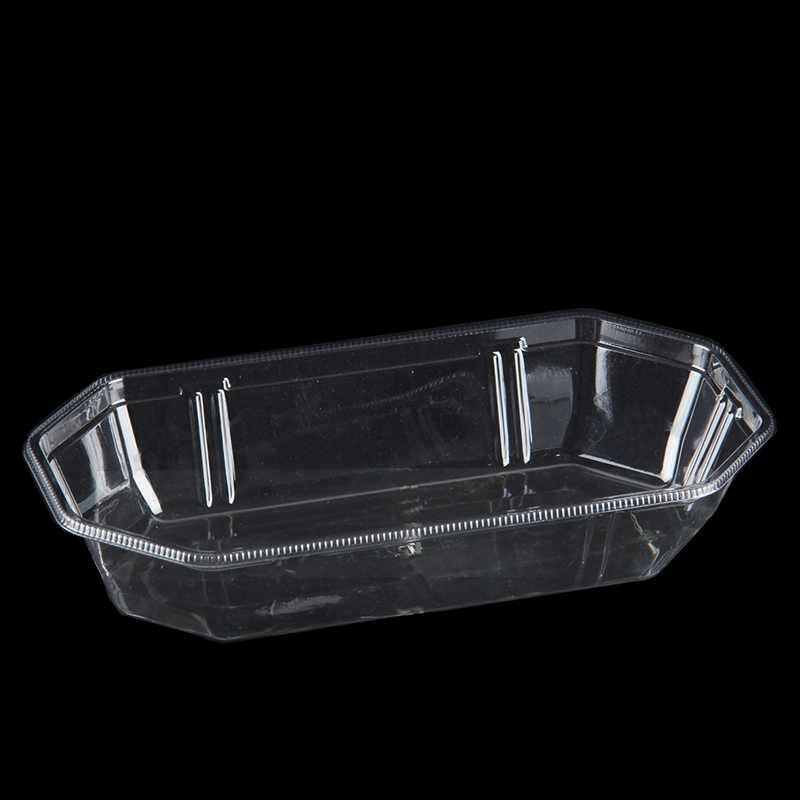
Machine-level controls directly translate to physical tray uniformity. The most sophisticated tooling in the world will fail if the heating and timing parameters are incorrect. Advanced thermoforming relies on manipulating the temperature of the sheet before it ever touches the mold. Operators must balance oven temperatures, index speeds, and forming pressures to achieve a stable process window.
Zoned temperature profiling is how operators control material flow. Modern thermoformers use quartz or ceramic heaters divided into precise, independently controlled grids. Operators intentionally under-heat the center of the sheet, which will eventually form the base of the tray. Simultaneously, they over-heat the perimeter of the sheet. Because cooler plastic resists stretching, the center retains its thickness as the plug pushes it down. The hotter, more pliable edges stretch easily to form the vertical sidewalls.
The dynamics shift dramatically between thin-gauge and heavy-gauge applications. Standard packaging utilizes thin-gauge roll stock, which heats rapidly. Heavy-gauge thermoforming, utilizing sheets exceeding 2mm in thickness, requires entirely different heating profiles. Thicker sheets demand prolonged, highly controlled heat soaking. If you heat a 3mm sheet too quickly, the outside scorches while the core remains rigid. This core rigidity causes severe base chilling and structural weakness during the draw.
Choosing between vacuum and pressure forming impacts base definition. Standard vacuum forming is limited to atmospheric pressure, providing roughly 14.7 psi of forming force. This is often insufficient for pushing material into tight base corners. Pressure forming encloses the sheet and introduces compressed air at up to 100 psi, working in tandem with the vacuum. This massive increase in force yields significantly tighter tolerances, sharper details, and a much more uniform base distribution.
Timing and sequencing represent the final process hurdle. Thermoforming relies on micro-second timing between plug insertion, vacuum application, and air ejection. The sequence must execute flawlessly every cycle:
If the vacuum engages a fraction of a second before the plug reaches its full stroke, the material will blow out and thin the base. If the cooling cycle is cut short, the base will warp upon ejection. Mastering this sequence is critical for maintaining base integrity across high-volume production runs.
The choice of thermoplastic fundamentally alters processing behavior, stretch characteristics, and end-use compliance. You cannot apply the same heating and forming parameters to different polymers and expect the same base uniformity. Each resin has a unique melt strength, sag tendency, and thermal conductivity that dictates how it behaves in the thermoformer.
Polyethylene Terephthalate (PET) is renowned for its excellent clarity, rigidity, and moderate melt strength. These characteristics make a PET plastic tray the absolute standard for retail environments. It performs exceptionally well as a supermarket fresh tray because it provides a strong oxygen barrier and high visibility. However, PET has specific heating requirements. If overheated, it crystallizes, turning cloudy and brittle. If under-heated, it resists the plug assist, causing severe base thinning and corner tearing. Operators must maintain strict oven temperature controls to keep PET in its optimal amorphous state during forming.
Polypropylene (PP) presents entirely different challenges. Often used for microwavable applications, PP has a notoriously narrow processing temperature window. It also exhibits a high tendency to sag when heated. As the sheet droops in the oven, it stretches under its own weight before forming even begins. Controlling base thickness in PP requires highly precise zoned heating and rapid plug-assist sequencing to catch the material before it sags out of control. Operators typically start with extruded sheet thicknesses of 0.3 to 0.9 mm for these applications and rely heavily on syntactic foam plugs to manage the material flow.
Specialized additives complicate material flow further. Base thinning disproportionately affects trays with functional requirements. Consider Electrostatic Discharge (ESD) trays used for sensitive electronics. The anti-static properties rely on conductive additives dispersed throughout the polymer matrix. If the base over-stretches and thins out, the distance between these conductive particles increases. This compromises the material's protective properties, allowing static buildup and dust accumulation. Similar issues occur with colorants; a thinned base will appear lighter in color than the thicker sidewalls, leading to visual rejection by quality control.
Uniform thermoforming is physically impossible without a uniform starting gauge. The extruded roll stock must possess strict cross-web thickness tolerances before it even enters the thermoformer oven. If the raw sheet has thick and thin bands from poor extrusion, the thermoforming process will only amplify those defects, making a uniform base unachievable. Manufacturers must audit their sheet suppliers to ensure the incoming raw material meets strict dimensional specifications.
| Polymer | Melt Strength | Sag Tendency | Forming Difficulty |
|---|---|---|---|
| PET | Moderate | Low | Medium |
| PP | Low | High | High |
| HIPS | High | Low | Low |
| PVC | Moderate | Medium | Medium |
Balancing the upfront cost of precision tooling against the ongoing costs of material waste and product failure is the core of thermoforming economics. Robust quality assurance protocols ensure that base thickness remains consistent across production runs of millions of units. You cannot manage what you do not measure, and measuring base thickness requires a combination of inline monitoring and destructive testing.
Non-destructive measurement allows operators to monitor base thickness during high-speed production without scrapping parts. Ultrasonic thickness gauges press against the base of the formed tray, using sound waves to calculate exact material thickness instantly. Inline vision systems monitor the overall geometry and light transmission of the trays as they exit the trim press. These cameras flag any units that exhibit the visual distortion characteristic of severe base thinning, allowing operators to adjust oven zones before producing thousands of defective parts.
Destructive testing remains necessary for initial setup and validation. During the First Article Inspection (FAI), quality engineers physically cut the tray into cross-sections. They use highly calibrated micrometers to verify the exact thickness at the base center, the base corners, and the sidewall transitions. This sectioning proves whether the plug-assist and zoned heating profiles are performing as engineered. Statistical Process Control (SPC) software tracks these measurements over time to identify tool wear or drifting oven temperatures.
Optimizing base thickness creates a massive financial advantage through down-gauging. If a manufacturer can guarantee a perfectly uniform base without thin spots, they can often reduce the starting thickness of the raw plastic sheet. Down-gauging reduces overall resin consumption, slashing material costs significantly without sacrificing the structural integrity or load-bearing capacity of the final product. This optimization requires tight collaboration between the tooling engineer and the machine operator.
Standard quality assurance steps for verifying base thickness include:
Buyers must rigorously evaluate potential thermoforming partners to avoid inconsistent production runs. The equipment and protocols a vendor utilizes directly dictate the quality of the final packaging. A vendor with outdated equipment will struggle to maintain base thickness tolerances, leading to rejected shipments and production line downtime.
Assessing equipment capabilities is the first step. Buyers must verify that a vendor utilizes modern, servo-driven thermoformers. Legacy pneumatic equipment relies on air pressure to drive the platens and plug assists. Pneumatics are susceptible to pressure fluctuations, causing inconsistent stroke speeds and unpredictable base thinning. Servo-driven machines provide absolute, repeatable control over positioning and speed down to the millimeter, ensuring the plug assist hits the exact same depth every single cycle.
Prototyping and Design for Manufacturing (DFM) are critical risk mitigation tools. Never commit to expensive, multi-cavity steel production tooling without running a prototype first. A prototype run utilizing a single-cavity aluminum or 3D-printed mold allows you to validate the draw ratio, test mated part tolerances, and measure actual base thickness. This step exposes design flaws before they become expensive production disasters. It also allows the vendor to dial in the exact plug geometry required for the specific polymer.
Process validation is mandatory for critical applications, such as medical device packaging or high-barrier food containers. Vendors must provide documented Installation Qualification, Operational Qualification, and Performance Qualification (IQ/OQ/PQ). This documentation proves mathematically that the vendor's equipment and process parameters can maintain base uniformity across millions of units, regardless of ambient factory conditions or operator shifts.
When auditing a new thermoforming vendor, require the following documentation:
Base thinning is an inherent physical challenge in thermoforming, driven by the natural stretching behavior of heated polymers. However, it is entirely solvable. Through the disciplined application of plug-assist tooling, strategic zoned heating, and precise process controls, manufacturers manipulate material flow to achieve perfectly uniform base thicknesses. When selecting a manufacturing partner, prioritize vendors who demonstrate in-house tooling expertise, utilize modern servo-driven equipment with zoned heating capabilities, and enforce rigorous quality control protocols for measuring base tolerances.
To ensure your next packaging project succeeds, take the following steps:
A: For most commercial packaging applications, the acceptable base thickness tolerance falls within ±10% to ±15% of the target specification. Tighter tolerances are often required for medical device packaging or high-barrier food containers to ensure structural integrity and proper hermetic sealing during transit.
A: Plug-assist utilizes a mechanical pusher to pre-stretch the heated plastic sheet into the mold cavity before vacuum is applied. This action physically carries a thicker mass of un-stretched material directly to the base, preventing the extreme thinning that occurs with vacuum-only forming.
A: A thin base usually results from an excessive draw ratio, lack of plug-assist tooling, or improper heating profiles. If the center of the sheet is heated too much, it stretches too easily. Using zoned heating to keep the center cooler forces the edges to stretch instead, preserving base thickness.
A: Yes. The draw ratio compares the depth of the tray to its width. A deep draw requires the plastic to stretch over a larger surface area. Without proper tooling like plug-assist, a deep draw causes severe base thinning, compromising the tray's load-bearing capacity and structural integrity.
A: If the base is too thin, the entire tray loses rigidity and begins to warp. This warpage distorts the dimensions of the tray's flange and lip. Once the flange geometry is altered, snap-on lids will not fit securely, and automated film sealing processes will fail.
A: Vacuum forming relies solely on atmospheric pressure to pull the plastic into the mold. Pressure forming adds compressed air to the non-mold side of the sheet. This higher force pushes material into tight corners more effectively, yielding sharper details and better base uniformity.


