


Phone:
+86-138-0577-0261


Views: 0 Author: Site Editor Publish Time: 2026-09-14 Origin: Site


Hidden operational costs exist within poorly designed packaging lines. When improper stacking occurs, facilities face automated line jams, damaged goods, and wasted freight space. Operations face a constant tension: maximizing stack density for shipping efficiency while ensuring reliable, high-speed separation on the production line. If a stack of containers locks together, the entire packaging line grinds to a halt. This requires manual intervention and causes unacceptable downtime. Controlling nesting depth requires precise thermoforming engineering, strategic draft angles, and specific structural features tailored to the food product's supply chain. Packaging engineers must balance the physical geometry of the container with the mechanical limits of denesting equipment. Understanding the mechanics of nesting pitch, material rigidity, and friction allows operations to eliminate double-picks, optimize pallet cube utilization, and maintain strict hygiene standards throughout the facility.
Understanding the distinction between total depth and nesting pitch is fundamental to packaging design. The overall depth refers to the physical height from the base of the container to its top flange. In contrast, the nesting pitch is the exact measurable distance between the rims of two stacked containers. When you stack fifty units, the nesting pitch determines the total height of that stack. Let us look at the math. If you have a 50mm deep plastic tray with a 5mm nesting pitch, a stack of 100 units will measure 545mm tall. If you increase that pitch to 10mm to improve separation, the same 100 units now measure 1040mm tall. This single dimension dictates your corrugated carton size, your pallet configuration, and ultimately your freight costs. Wall height is often dictated by what the food actually does rather than just portion volume. For instance, flat display items typically require shallow depths under 25 mm to present the product effectively to the consumer. A deeper container would obscure the product and waste material. The nesting pitch must be engineered so that these shallow containers do not compress into a solid block during transit.
When you place one container inside another, several physical forces immediately act upon them. Friction occurs where the sidewalls meet. If the walls are too steep or the nesting pitch is too tight, the surface area contact increases, multiplying the friction. Static electricity also plays a significant role, particularly in dry warehouse environments during winter months. Polymer materials naturally hold a static charge generated by friction during the thermoforming process and transit vibrations. This triboelectric charging causes lightweight containers to cling together aggressively. Furthermore, a vacuum force can develop if air is pushed out from between the two nested units. When a heavy load compresses a stack, it forces the ambient air out of the microscopic gaps between the plastic surfaces. Without mechanical features to maintain an air gap, atmospheric pressure locks the containers together. This suction effect makes them nearly impossible for automated machinery to separate without damaging the flange.
The manufacturing process itself dictates how a container must be shaped. During thermoforming, a heated polymer sheet indexes over a mold cavity. Plug assists push the material down, and vacuum pressure draws the plastic tight against the chilled aluminum tooling. Because the material shrinks slightly as it cools, vertical walls are impossible for nested containers. If a mold had perfectly straight 90-degree walls, the cooled plastic would seize onto the tooling, preventing ejection. Draft angles are introduced to facilitate both mold release and end-user separation. The mold cavities determine the final shape, meaning every contour, rib, and corner must be designed with both the forming process and the eventual stacking behavior in mind. You cannot simply design a box; you must design a geometry that releases from metal and releases from itself.
High-speed packaging lines rely on automated denesters to feed containers onto the conveyor. These machines typically use screw mechanisms, vacuum cups, or pick-and-place arms to strip the bottom unit from a vertical stack. Screw denesters use rotating threads that catch the flange of the container and pull it downward onto the belt. If the nesting pitch is inconsistent, the screw thread will miss the flange or grab two flanges simultaneously. This results in "double-picks," where two nested units are fed onto the line at once. When a double-pick reaches the filling station, product spills over the sides, contaminating the sealing area. This causes machine faults, rejected packages, and massive messes on the conveyor belt. The resulting line downtime severely impacts daily throughput. Vacuum denesters face similar issues. If the vacuum cups pull down but the containers are locked by static or friction, the machine will either drop the stack or tear the plastic flange.
When troubleshooting denesting failures, operators should follow these steps:
The financial impact of nesting pitch on pallet density cannot be ignored. Cube utilization refers to how efficiently product fills the available space in a shipping truck or warehouse rack. A tighter nesting pitch allows more units to fit into a single corrugated carton, reducing the total number of pallets required for a shipment. This directly lowers freight costs and frees up valuable warehouse space. You are essentially trying to avoid shipping empty air. However, packaging engineers must calculate the precise trade-off. Pushing the nesting pitch too tight increases the risk of containers locking together under the heavy compressive load of a fully stacked pallet. A pallet stacked two meters high exerts immense downward pressure on the bottom cartons. If the plastic yields and the denesting lugs bypass each other, the stack becomes a solid brick. The savings in freight are quickly negated if production operators have to manually pry containers apart on the factory floor.
In facilities utilizing reusable or washed packaging systems, nesting depth directly impacts sanitation. "Wet nesting" occurs when washed containers are stacked tightly before they are completely dry. Insufficient spacing traps moisture between the layers, creating a dark, damp environment that promotes rapid bacterial and fungal growth. This directly impacts health code compliance and can cause a facility to fail safety audits. Proper nesting features ensure a physical gap remains between stacked units, allowing ambient air to circulate and evaporate residual moisture. In fresh produce applications, this same airflow is necessary to prevent condensation build-up before the container is even filled. When moving containers from a warm loading dock to a cold storage room, condensation forms rapidly. If the stack is too tight, that moisture stays trapped, keeping the facility from remaining inspection-ready.
To prevent containers from wedging together, engineers incorporate physical stops into the design. Denesting lugs are small protrusions, undercuts, or indents strategically placed in the corners or along the sidewalls. Stacking shoulders act as a continuous ledge around the perimeter. When stacked, the bottom of the top container rests precisely on the lugs or shoulders of the container below it. These features bear the entire weight of the stack. By transferring the compressive load to these reinforced points, the sidewalls are kept separated, maintaining a consistent air gap and preventing vacuum locks. The geometry of these lugs is highly specific. They must be pronounced enough to catch the container above them, but smooth enough to release instantly when pulled by a denester. We often use corner lugs because the corners of a thermoformed part are naturally more rigid due to the geometry of the draw.
Draft angles are the slight tapers applied to the vertical walls of a thermoformed part. Technical guidelines typically require a draft angle of 2° to 5°. A wider draft angle makes separation easier but reduces the internal volume available for the food product. Deeper containers require careful draft angle calculation to maintain structural integrity without compromising the necessary internal space. If a deep draw container has a draft angle that is too narrow, the extensive surface area contact will cause severe friction locking. Engineers use CAD software to simulate stacking behavior, adjusting the draft angle incrementally until the optimal balance between volume and separation is achieved. You also have to account for material distribution. As plastic stretches down into a deep mold, it thins out. A proper draft angle helps maintain a more uniform wall thickness, which in turn supports the nesting lugs.
The gauge, or thickness, of the plastic sheet heavily influences nesting behavior. A container formed from a thick, rigid gauge will maintain its shape under pressure, allowing the denesting lugs to function as designed. Conversely, overly thin materials lack structural column strength. When subjected to the weight of a high stack, thin sidewalls can buckle or deform. This deformation allows the container to slip past the denesting lugs, overriding the engineered stops. Once the lugs are bypassed, the containers wedge tightly together. Specifying the correct material gauge is critical to ensuring the structural features perform reliably under real-world warehouse conditions. Down-gauging to save money on material costs often backfires if it leads to increased line jams and wasted labor. You must test the compressive strength of the empty stack before approving a thinner material.
Meat and poultry packaging operates in highly demanding environments. A supermarket fresh tray must withstand high-speed automated denesting, rapid filling, and hermetic sealing processes. The primary success criteria revolve around maintaining absolute structural integrity. The design focus requires highly rigid denesting lugs to handle the impact forces of automated machinery. Furthermore, the flange design must be perfectly flat and robust. If improper nesting causes the flange to distort or warp while sitting in a stack, the subsequent Modified Atmosphere Packaging (MAP) seal will fail. A compromised seal leads to premature spoilage, gas leaks, and costly retail rejections. The denesting features must protect the flange at all costs, ensuring it remains pristine from the thermoformer to the sealing die.
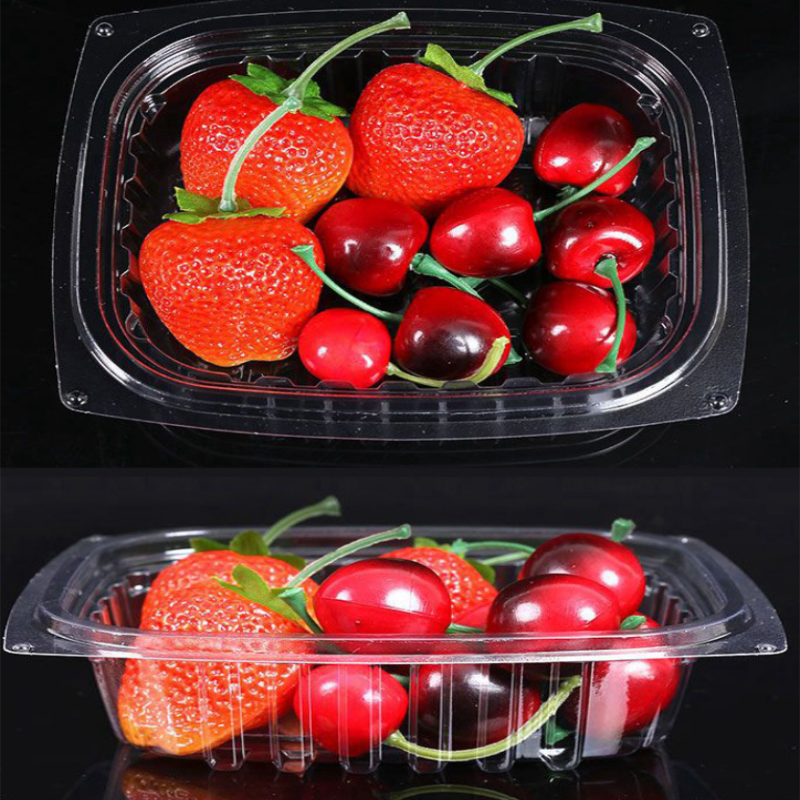
Produce packaging balances protection with environmental control. A recyclable PET fruit tray must protect delicate items like berries or grapes from bruising while allowing rapid forced-air cooling. The design focus here involves the precise integration of ventilation holes. These holes must align perfectly when the containers are nested to allow airflow through the entire stack during storage. Additionally, engineers must manage the specific friction coefficients and static cling inherent to recycled PET (rPET) materials. rPET can be more prone to static build-up than other polymers, requiring specialized tooling adjustments and distinct lug geometries to ensure smooth separation without damaging the fragile produce. We often add subtle ribbing to the sidewalls to reduce surface contact area, which helps break the static bond between nested rPET units.
Commercial kitchens and ghost kitchens operate at a frantic pace. A food delivery tray prioritizes manual separation speed and structural rigidity during transit. Line cooks do not have time to struggle with stuck containers during a dinner rush. The success criteria demand that a worker can grab a single unit effortlessly with one hand. The design focus shifts toward wider draft angles and highly pronounced stacking shoulders. These features create a larger, more forgiving nesting pitch. While this slightly reduces shipping density compared to high-speed automated packaging, the trade-off is necessary to maintain kitchen efficiency and ensure the container remains rigid enough to protect hot, heavy meals during delivery. The manual ergonomics of the container take precedence over maximizing pallet density.
The primary compromise in packaging design is balancing freight efficiency against operational reliability. Maximizing the number of units per box lowers freight costs significantly. However, pushing the nesting pitch to its absolute minimum increases the risk of automated denesters failing. If a machine jams, the operational cost of manual intervention, line downtime, and wasted product quickly exceeds the initial freight savings. Operations managers must analyze their specific production line capabilities. A facility with state-of-the-art vacuum denesters can handle a tighter nesting pitch than a facility relying on older, less precise mechanical screw denesters. You have to audit your own equipment before dictating a nesting pitch to your packaging supplier.
Designing custom thermoforming molds with complex denesting features requires upfront capital investment. Precision CNC machining is needed to create the intricate undercuts and lugs that control nesting depth. However, this upfront tooling cost must be framed against long-term operational savings. Reliable nesting eliminates double-picks, reduces product waste, and prevents line stoppages. Furthermore, optimized logistics from better cube utilization provide ongoing freight reductions. Investing in high-quality tooling yields a rapid return on investment by stabilizing the entire packaging operation. Cheap tooling often lacks the precise temperature control and vacuum distribution needed to form sharp, effective denesting lugs, leading to inconsistent stacks and daily headaches on the production floor.
When evaluating tooling investments, consider these operational factors:
Different polymers behave differently when stacked. Polypropylene (PP), Crystallized PET (CPET), and rPET each have unique friction coefficients and shrinkage rates. PP is generally softer and more flexible, which can lead to deformation if the stack is too heavy. rPET is stiffer but more susceptible to static cling. To mitigate these risks, manufacturers may apply anti-static additives during the extrusion process or design specific nesting geometries that minimize surface area contact. Understanding how the chosen material interacts with the tooling is essential for consistent production. You cannot simply swap materials in the same mold and expect the nesting behavior to remain identical.
| Material Type | Rigidity | Friction Coefficient | Primary Nesting Risk | Common Application |
|---|---|---|---|---|
| Polypropylene (PP) | Medium/Flexible | Low to Medium | Deformation under heavy stack weight | Microwaveable meals |
| Recycled PET (rPET) | High/Stiff | Medium to High | Static cling and vacuum locking | Fresh produce, cold deli |
| Crystallized PET (CPET) | Very High | Medium | Brittle cracking if lugs are misaligned | Oven-ready meals |
To ensure your packaging lines run without interruption, implement the following steps:
A: Typically 2 to 5 degrees, depending on the material thickness and depth of the draw, to ensure easy mold release and reliable denesting.
A: They are structural protrusions that create a physical gap between stacked trays, preventing them from wedging together and creating a vacuum seal.
A: Jams are usually caused by insufficient nesting pitch, lack of denesting lugs, static electricity, or trays deforming under the weight of the stack.
A: Wet nesting occurs when washed or damp trays are stacked too tightly, trapping moisture and creating an environment for bacterial growth, which can cause a facility to fail health inspections.
A: Yes, materials like rPET may have different friction coefficients and static properties compared to PP, requiring specific tooling adjustments to ensure smooth separation.
A: Nesting pitch is measured as the distance from the top edge of one tray to the top edge of the tray nested immediately inside it.
A: Wall height is often decided by what the food does rather than just volume. For example, flat display items typically require shallow depths under 25 mm, while bulkier items require deeper draws with carefully calculated draft angles.


