


Phone:
+86-138-0577-0261


Views: 0 Author: Site Editor Publish Time: 2026-09-14 Origin: Site


Misplaced weighing labels on packaging lead to unreadable barcodes, compromised adhesive integrity, and checkout bottlenecks that directly impact operational efficiency. In high-traffic retail and packaging environments, standardizing where a label is applied to a plastic tray remains an absolute necessity. Poor placement results in barcode distortion on curved edges, adhesive failure from condensation, and inaccurate tare weight calculations during the weighing process. When operators slap labels on haphazardly, scanners fail to read the data. This forces cashiers to manually enter codes, slowing down the entire line. Determining the optimal label placement requires evaluating the tray’s geometry, the material composition of the packaging, and the storage environments. You must also account for the specific label printing scale hardware and POS software utilized on the production floor or deli counter. Fixing this issue prevents lost revenue and keeps your packaging lines moving without interruption.
Defining a successful label application goes beyond merely sticking a piece of paper onto a surface. True success in packaging operations requires a 100% first-pass scan rate at the checkout terminal. It demands zero edge peeling, even when the packaging moves through highly humid environments or blast chillers. Furthermore, successful placement ensures strict adherence to local weights and measures regulations. A label must remain perfectly flat to maintain the integrity of the barcode's quiet zones. Any deviation or wrinkling compromises the scanner's ability to read the data. This leads to manual overrides that slow down throughput and introduce human error.
To evaluate your current labeling process, measure it against these specific field criteria:
Cold storage environments introduce significant physical challenges to label adhesion. When packaging moves from a 38°F cold prep room to a 65°F display area, condensation immediately begins to form. Top-facing surfaces often accumulate the most moisture. This pooling water quickly degrades standard thermal paper labels, causing the print to fade or the paper itself to disintegrate. Understanding the dew point and how moisture interacts with the packaging material helps you select the right adhesive and the right placement zone.
Static electricity presents another invisible hurdle on the packaging line. Plastic packaging naturally generates a static charge during the thermoforming process and subsequent handling. This static charge on a tray can interfere with precision scale readings. It causes micro-fluctuations that prevent the scale from locking onto a stable weight. Additionally, static attracts micro-dust and airborne particulates to the tray's surface. This invisible layer of dust severely weakens the initial adhesive tack of the label. It leads to premature peeling before the product even reaches the display shelf.
| Environmental Factor | Impact on Label Adhesion | Recommended Mitigation Strategy |
|---|---|---|
| Condensation (Cold to Warm) | Moisture degrades paper stock and weakens water-based adhesives. | Utilize side-wall placement and specify moisture-resistant top-coated labels. |
| Static Electricity | Attracts dust, weakening initial tack; disrupts scale stabilization. | Install anti-static bars on the conveyor line prior to the labeling station. |
| Blast Chiller Temperatures | Causes standard adhesives to freeze, crystallize, and detach. | Apply labels at room temperature using specialized cold-temp rubber adhesives. |
| Overhead Heat Lamps | Turns direct thermal labels black; melts standard adhesives. | Use thermal transfer labels and place them on the side walls away from direct heat. |
Consistent label placement directly impacts the calibration and operational flow of label printing scales, such as Easy Weigh or SATO systems. When operators apply labels haphazardly, they introduce variability into the weighing process. Automated systems rely on predictable tare weights. If a label is placed over a thick structural ridge rather than a flat zone, it alters how the package sits on the scale platter. This physical imbalance skews the final measurement.
Regulatory compliance demands absolute precision on the floor. Official bulk-weighing scale accuracy tests require factoring the label's weight and placement into the equation. Technicians utilize precision test weights, typically amounting to at least 1/10 of the scale's total capacity, to verify exact tare deductions. If the combined tare of the packaging and the label is not accurately deducted, the facility risks compliance violations and fines for overcharging consumers. Standardizing where the label goes ensures the tare weight remains a constant, reliable variable across thousands of units.
Placing the label on the top surface offers maximum visibility for consumers. Shoppers can instantly read the weight, price, and nutritional information without handling the product. This location is also the easiest for manual application at deli or meat counters. Operators quickly slap the label on and hand the item over. For automated overhead scanners in high-traffic areas managing bulk items, top placement works perfectly. However, this area is highly susceptible to moisture pooling if the product is stored in open refrigerated cases. A large label can also obstruct product visibility, hiding the quality of the meat or produce inside. This placement works best for dry goods or tightly shrink-wrapped supermarket fresh tray applications where condensation is actively managed.
Utilizing the side-wall leaves the top completely clear for product viewing. Shoppers inspect the contents without obstruction. Side walls are less prone to direct overhead moisture accumulation. They also avoid drafts from open refrigeration units that cause micro-fluctuations on highly sensitive scales. The primary drawback is the limited surface area. You face a high risk of barcode distortion if the side-wall curves, tapers, or features structural ribbing. Furthermore, side labels require a specific scanner orientation at checkout. This slows down cashiers if they have to hunt for the barcode. Side-wall placement fits deep-profile trays where the vertical walls offer at least two inches of continuous, flat space.
Bottom-surface placement completely preserves product visibility. The label remains entirely protected from top-down condensation, overhead lighting heat, and handling abrasion from shoppers picking up and putting down the item. Despite these protective benefits, bottom placement requires the cashier or consumer to physically flip the product to scan it. This action risks spills, damages delicate produce, and significantly slows down high-traffic checkout lanes. It is also impossible to read the label while the product is actively resting on a scale. Therefore, bottom placement serves best for secondary regulatory labeling or bulk items where the top-surface real estate is already exhausted by branding.
Wrap-around labeling provides a massive surface area for nutritional data, weighing metrics, and branding. Because the label spans from the top, down the side, and under the bottom, it acts as a highly effective tamper-evident seal. The major disadvantage is the high risk of adhesive failure at the tension points. The sharp 90-degree corners create memory in the label material. This causes it to pull away from the plastic if the adhesive is not sufficiently aggressive. This method requires specialized materials and precise automated application machinery. Wrap-around labels are highly recommended for high-security packaging, such as a food delivery tray or premium ready-to-eat meals where chain of custody matters.
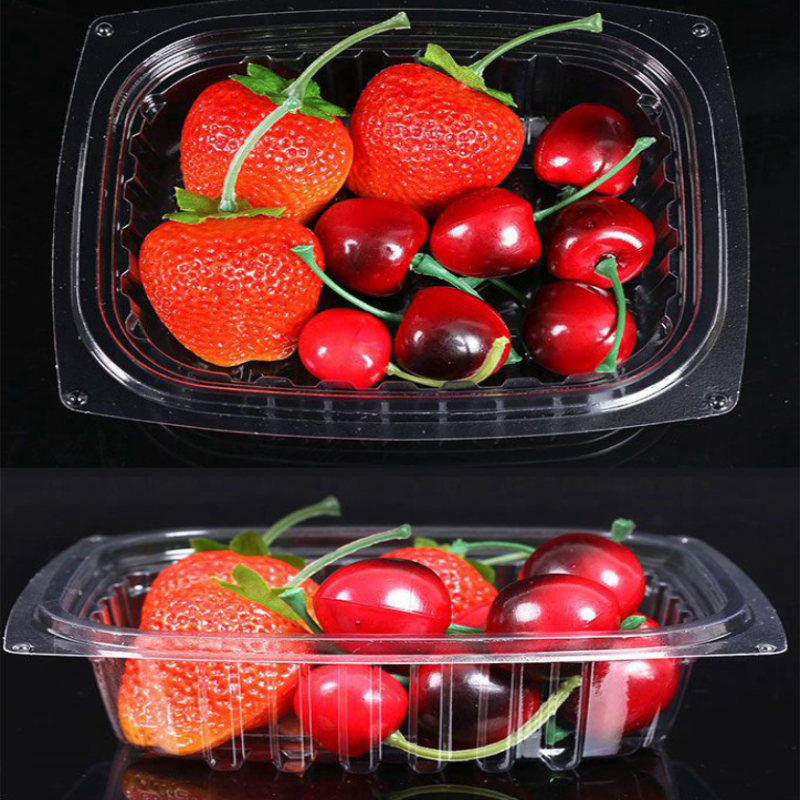
Polyethylene terephthalate (PET) is highly favored for its clarity and recyclability, but it presents specific labeling challenges. PET has a relatively low surface energy. This physical characteristic means standard adhesives struggle to "wet out" or spread effectively across the surface. This leads to poor initial tack and long-term label adhesion failures. When dealing with a recyclable PET fruit tray, operators face a strict trade-off. Using highly aggressive, permanent adhesives ensures the label stays attached during cold storage and transit. However, these same permanent adhesives contaminate the recycling stream, ruining the very sustainability the PET material was chosen for. Facilities must source wash-away or recycling-compatible adhesives. These provide enough tack for the retail lifecycle but separate cleanly during the recycling wash process.
Different plastic polymers require different adhesive formulations. Polystyrene, often used in foam meat trays, has a porous surface texture. Polypropylene, used in microwave-safe deli containers, is non-porous and highly resistant to heat. The porosity of the surface dictates the choice between acrylic-based and rubber-based label adhesives. Rubber-based adhesives generally offer higher initial tack on porous surfaces but degrade quickly under UV light or extreme temperature shifts. Acrylic adhesives perform better on non-porous surfaces and withstand temperature fluctuations. This makes them ideal for freezer-to-microwave applications. Furthermore, the physical design of the tray matters. Heavy structural ribbing or embossed logos on the bottom of a polypropylene container eliminate available flat labeling zones. This forces operators to utilize the lid or side walls regardless of adhesive compatibility.
| Plastic Material | Surface Characteristic | Optimal Adhesive Type | Primary Labeling Challenge |
|---|---|---|---|
| PET (Polyethylene Terephthalate) | Low surface energy, smooth | Wash-away acrylic (for recycling) | Balancing strong adhesion with recycling stream compatibility. |
| Polystyrene (Foam) | Porous, textured | Rubber-based permanent | Adhesive sinking into pores, reducing surface contact area. |
| Polypropylene (PP) | Non-porous, heat resistant | High-temp acrylic | Navigating heavy structural ribbing often molded into the tray base. |
The choice of weighing and printing hardware heavily dictates label placement options on the packaging line. Utilizing advanced systems like Application Enabled Printing (AEP) on a SATO FX3-LX allows for PC-less printing directly at the packaging station. This rapid, decentralized workflow requires trays to have easily accessible, top-facing zones for immediate manual application. If the workflow relies on automated print-and-apply systems in high-traffic areas, the packaging must be perfectly aligned on the conveyor. Automated tamp-pads require a perfectly flat, horizontal target. If the tray design features a domed lid or aggressive side tapers, the automated applicator will misapply the label. This causes wrinkles that render the barcode unreadable.
Label size is not arbitrary; it is dictated by the data requirements of the facility's software. Adding new products and managing PLUs (Price Look-Up codes) via IPOS software directly impacts label dimensions. Ingredient-heavy items, allergen warnings, and complex nutritional panels require significantly larger labels. When the software pushes this dense data to the printer, the resulting large label eliminates side-wall placement options on standard shallow trays. Operators must synchronize their POS data management with their physical packaging inventory. This ensures the required data actually fits on the designated flat zones of the tray.
Scanning hardware relies on strict geometric standards to function. Every barcode requires a "quiet zone"—a blank, unprinted space immediately preceding and following the barcode lines. This quiet zone signals to the scanner where the data begins and ends. Placing labels near the lip, ridge, or curved corner of a tray often forces the quiet zone to bend. When the quiet zone bends away from the scanner's laser or camera, the scan fails. Technical requirements dictate that the entire barcode and its surrounding quiet zones must reside on a perfectly flat plane. Ignoring this rule in favor of aesthetic placement guarantees checkout bottlenecks.
Improperly loaded label rolls or incorrect label settings on scales, such as the Easy Weigh LS-100, frequently result in misaligned prints. When the print alignment shifts, the barcode or critical weight data bleeds off the edge of the label. Consequently, when applied to the tray's designated flat zone, the data wraps around a corner or gets cut off entirely. To mitigate this risk, facilities must implement standardized operator training. Staff must be trained not only on changing label rolls but also on executing test prints. They must adjust scale calibration settings to ensure the print perfectly matches the label stock and the tray's geometry.
Labels face severe environmental stress from the moment they are applied. Thermal print fading is a massive risk when packaging is placed under deli heat lamps or subjected to the rapid temperature drops of blast chillers. Standard direct thermal labels will turn completely black under heat lamps or lose their image entirely in humid freezers. To mitigate environmental degradation, operators must specify top-coated thermal labels. These feature a protective barrier against moisture, oils, and heat. Additionally, selecting tray areas with the least temperature variance—such as the side walls rather than the direct top surface under a lamp—preserves the print integrity.
Human error remains the largest variable in manual labeling operations. Staff working in fast-paced environments often apply labels haphazardly. They slap them on at angles or over structural ridges. This inconsistency leads to unreadable weights, failed scans, and forced manual checkout entry. Mitigating operator inconsistency requires physical interventions. Facilities should implement physical application jigs at the weighing station. These guide the operator's hand to the exact same spot every time. Alternatively, sourcing trays with subtly embossed labeling guides or recessed label panels forces the operator to place the label in the correct, standardized location.
A: Place the label on a flat, top-facing surface if the product is tightly wrapped to prevent condensation pooling. If condensation is unavoidable, use a specialized cold-temp adhesive on the side-wall to avoid direct overhead moisture entirely.
A: While placement doesn't change the gross weight, inconsistent placement causes automated print-and-apply systems to misfeed or apply labels over tray ridges. This alters how the tray sits on the scale platter, leading to unreadable barcodes and compliance failures.
A: Official bulk-weighing scales should be calibrated using precision test weights that equal at least 1/10 of the scale's total capacity. This ensures the combined tare of the tray and the label is accurately and consistently deducted.
A: Yes, but it is generally discouraged for primary weighing labels. It requires cashiers to flip the product during checkout, which slows down high-traffic lanes, risks damaging soft produce, and increases the likelihood of spills.
A: Ensure the designated label area is completely dry and free of condensation before application. Utilizing an adhesive specifically formulated for low surface energy plastics secures the bond without compromising the tray's recyclability during the wash process.
A: Yes. Static charge generated during thermoforming attracts micro-dust to the tray surface. This invisible dust layer weakens the initial adhesive tack, causing the label to peel prematurely before reaching the retail shelf.


