


Phone:
+86-138-0577-0261


Views: 0 Author: Site Editor Publish Time: 2026-09-20 Origin: Site


The structural integrity and safety of food packaging directly impact shelf life, transport viability, and brand perception. Packaging failures during transit or retail display lead to immediate product loss, compromised logistics, and damage to consumer trust. Procurement and packaging engineers must balance material performance, regulatory compliance, and sustainability mandates when selecting packaging solutions. Choosing the wrong material or a manufacturer with subpar forming processes leads to increased spoilage, inefficient supply chains, and failed sustainability audits.
Understanding the exact manufacturing process of a Polyethylene Terephthalate (PET) plastic tray—from resin extrusion to thermoforming—provides the technical baseline required to evaluate supplier capabilities. This knowledge allows procurement teams to accurately assess tooling investments, audit quality control protocols, and select the right packaging architecture for specific food applications.
Polyethylene Terephthalate (PET) holds a dominant position in cold-chain and ambient food packaging due to its specific polymer characteristics. When compared to alternatives like Polypropylene (PP) and Polystyrene (PS), PET offers a superior combination of optical clarity, high tensile strength, and excellent gas and moisture barrier properties. PP, while offering higher heat resistance, naturally exhibits a cloudy appearance that obscures product visibility. PS, particularly in its oriented or expanded forms, lacks the durability required for modern logistics and faces increasing regulatory restrictions. PET provides the necessary structural rigidity to protect fragile contents while maintaining the glass-like transparency that drives retail sales.
To understand why packaging engineers specify PET over other commodity polymers, we must look at the mechanical and thermal properties that dictate field performance. The table below outlines the baseline characteristics of common thermoforming plastics used in food packaging.
| Polymer Type | Optical Clarity | Oxygen Barrier (OTR) | Cold Impact Strength | Heat Resistance | Primary Application |
|---|---|---|---|---|---|
| APET (Amorphous PET) | Excellent (Glass-like) | High | Excellent | Low (Up to 70°C/160°F) | Refrigerated produce, deli meats, bakery |
| CPET (Crystallized PET) | Opaque | High | Good | High (Up to 200°C/400°F) | Oven-ready meals, hot-fill applications |
| PP (Polypropylene) | Hazy / Translucent | Low | Poor (Brittle at freezing) | Medium (Up to 120°C/250°F) | Microwaveable containers, hot deli items |
| OPS (Oriented Polystyrene) | Good | Low | Poor (Prone to cracking) | Low (Up to 85°C/185°F) | Short shelf-life bakery, lightweight clamshells |
The baseline PET polymer is highly adaptable. Manufacturers modify the sheet extrusion and thermoforming parameters to meet the precise demands of different food categories. Tooling geometry and chemical additives transform a standard sheet of plastic into a highly specialized packaging component.
The economic advantage of PET lies in its high strength-to-weight ratio. Advanced thermoforming techniques allow for significant lightweighting—reducing the gauge of the plastic sheet without sacrificing the structural integrity of the final tray. Strategic ribbing and geometric reinforcement in the mold design provide the necessary crush resistance using less raw material. This reduction in polymer weight directly lowers unit costs and decreases shipping weights, optimizing the overall logistics footprint.
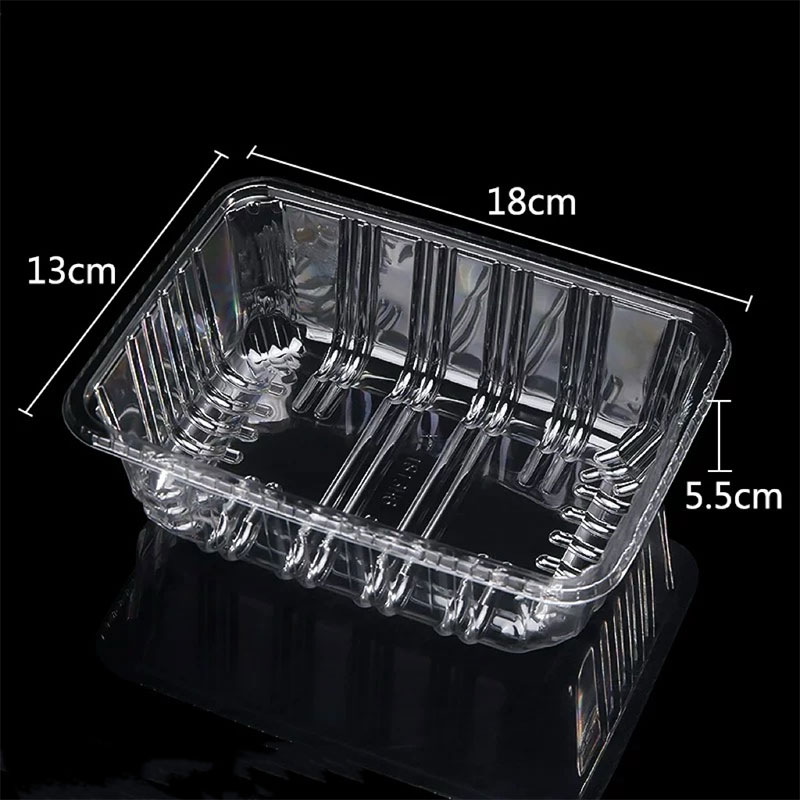
Producing a high-quality Plastic Tray requires strict control over thermal and mechanical variables. The process moves continuously from raw resin handling to final part extraction. Any deviation in temperature, pressure, or timing results in structural defects.
PET is a hygroscopic polymer, meaning it naturally absorbs moisture from the ambient air. Before processing, this moisture must be entirely removed. If wet PET pellets enter the high-temperature extrusion barrel, the water reacts with the polymer chains in a process called hydrolytic degradation. This chemical reaction breaks the polymer chains, significantly lowering the material's intrinsic viscosity (IV). Trays made from degraded PET will be brittle, prone to cracking, and structurally compromised.
The dried PET pellets feed into an extruder, where a rotating screw shears and melts the plastic through mechanical friction and external heater bands. The molten polymer is forced through a wide, flat coat-hanger die, emerging as a continuous sheet.
Thermoforming transforms the flat extruded sheet into a three-dimensional tray. The process requires precise thermal management and mechanical force. Modern inline systems feed the extruded sheet directly into the thermoformer, utilizing the residual heat from extrusion to save energy.
Once formed, the continuous web of trays moves to a trim station. Steel rule dies or matched metal punch tools cut the individual trays from the surrounding plastic web. The finished trays are automatically stacked and counted for boxing.
The remaining skeletal web—the plastic left over after the trays are cut out—is immediately fed into a granulator. This regrind is then mixed with virgin resin at a controlled ratio and fed back into the extruder, minimizing material waste. Inline automated optical inspection systems scan the moving web for defects such as black specks, un-melted resin, or dimensional inaccuracies, ensuring only compliant trays reach the packing station.
Evaluating a supplier requires looking beyond the unit price and auditing the physical characteristics of the thermoformed product. Poor manufacturing controls manifest as specific, measurable defects in the final tray. Procurement teams must establish strict quality control parameters.
Consistent material distribution is a non-negotiable success criterion. During the thermoforming process, plastic naturally thins out as it stretches into the corners of a mold. If a manufacturer fails to optimize the plug assist timing, plug geometry, or heating profile, the bottom corners of the tray will become dangerously thin. Thin corners lead to structural failure during pallet stacking or transit. Procurement teams should request sectioned samples and use micrometers to verify that the wall thickness in the deepest draw areas meets the specified minimum gauge.
Optical clarity directly impacts consumer perception of food freshness. The clarity of PET is measured by its haze index. Excessive cloudiness or a milky appearance indicates poor thermal management during the extrusion phase—specifically, failing to quench the extruded sheet fast enough on the chill rolls, allowing unwanted crystallization. High haze levels can also indicate the use of low-quality, contaminated recycled resin or excessive regrind ratios. Acceptable haze levels must be defined in the procurement specification.
For applications utilizing Modified Atmosphere Packaging (MAP), the precision of the tray's top flange is critical. The flange must be perfectly flat and free of any tooling marks, warpage, or plastic strings (angel hair) caused by dull trimming dies. When a top film is heat-sealed to the tray, any deviation in flange flatness creates microscopic channels. These channels result in seal failures, gas leaks, and accelerated food spoilage, rendering the MAP technology useless.
For applications that rely on mechanical lids rather than heat-sealed films, dimensional stability is paramount. The rim of the tray and the corresponding lid must match within tight tolerances. PET shrinks slightly as it cools after thermoforming. If the manufacturer does not accurately account for this shrinkage rate in the mold design, or if they run the cooling cycle too fast to artificially boost production speeds, the final dimensions will vary. Poor tolerances lead to loose closures, causing lids to pop off during handling or transit.
| Common Defect | Visual / Physical Indicator | Root Cause in Manufacturing | Procurement Audit Action |
|---|---|---|---|
| Thin Corners | Tray crushes easily at the base; micrometer reads below spec. | Incorrect plug assist timing; uneven oven heating profile. | Request corner gauge measurements on first-article inspections. |
| High Haze (Cloudiness) | Milky appearance; poor product visibility. | Slow chill roll quenching; wet resin; degraded regrind. | Specify maximum haze percentage; audit resin drying logs. |
| Warped Flanges | Uneven top rim; MAP seal failures. | Inadequate mold cooling time; aggressive ejection from mold. | Test samples on production sealing equipment before approval. |
| Angel Hair | Fine plastic strings attached to the trimmed edges. | Dull trim dies; incorrect trim press alignment. | Inspect samples for clean cuts; ask about die maintenance schedules. |
Selecting the right packaging requires understanding the physical limitations of the material and the operational constraints of the manufacturing process. Failing to account for these variables leads to costly production delays and product failures.
The primary limitation of standard amorphous PET (APET) is its low heat resistance. Standard PET begins to soften and deform at temperatures above 70°C (160°F). It is strictly designed for cold-chain, ambient, or slightly warm applications. It cannot be used for hot-fill processes, pasteurization tunnels, or consumer microwave heating. To mitigate this risk for heat-intensive applications, procurement must specify Crystallized PET (CPET), which undergoes a specialized heat-setting process in the mold to withstand oven temperatures up to 200°C, or switch to Polypropylene (PP), which naturally handles microwave temperatures.
Developing a custom tray requires significant upfront capital expenditure for tooling. A high-cavitation production mold machined from aluminum, complete with water cooling channels and syntactic foam plugs, represents a substantial investment. Lead times for custom tooling typically range from 4 to 8 weeks. Procurement teams must evaluate the trade-offs between utilizing a manufacturer's existing stock molds and investing in custom tooling. Stock molds offer zero upfront tooling costs and a faster time-to-market. However, custom tooling allows for precise optimization—such as matching the exact dimensions of an automated denester, maximizing pallet cube efficiency, or embossing brand logos directly into the plastic.
High-speed, multi-station thermoforming equipment is designed for continuous, high-volume production. The setup and changeover times for these massive machines dictate high Minimum Order Quantities (MOQs). Running small batches is economically unviable due to the scrap generated during machine calibration and thermal stabilization. Procurement must balance the lower unit costs of large production runs against the warehouse storage requirements and inventory capital tied up in holding bulky, empty plastic trays. Just-in-time (JIT) delivery agreements are often negotiated to manage this physical footprint.
Packaging selection is heavily scrutinized by regulatory bodies and consumers. Navigating the end-of-life realities of PET requires a clear understanding of recycling infrastructure and material science.
PET is one of the most widely recycled plastics globally, but its recyclability depends heavily on its final format. Industry standards, such as the How2Recycle guidelines, emphasize that clear, unpigmented PET is the gold standard for circularity. Clear PET yields the highest value in the secondary commodity market because it can be recycled into a wide variety of new products, including new food-grade packaging, strapping, or polyester fibers.
Using black plastic for food trays severely compromises recyclability. Material Recovery Facilities (MRFs) rely on Near-Infrared (NIR) optical sorters to identify and separate different polymer types on high-speed conveyor belts. The carbon black pigment traditionally used to color PET absorbs the NIR light rather than reflecting it back to the sensor. Consequently, the optical sorters fail to detect the black PET tray, and it is typically routed to the landfill residue stream, rendering it effectively non-recyclable despite being made of a highly recyclable polymer.
A tray's recyclability is often dictated by what is attached to it. Heavy paper labels with aggressive adhesives, thick heat-seal coatings, and incompatible multi-material top films contaminate the PET recycling stream. When these trays enter the recycling wash plant, incompatible materials fail to separate cleanly from the PET flakes during the density sink-float process. Packaging engineers must specify easily peelable films, water-soluble adhesives, or compatible mono-material seals that do not degrade the quality of the recycled PET output.
Integrating Post-Consumer Recycled (PCR) PET into new food packaging is a primary sustainability goal. However, using recycled material for direct food contact requires strict regulatory compliance. To ensure safety, manufacturers often utilize an ABA co-extrusion process. This technique sandwiches a core layer of rPET (recycled PET) between two outer layers of virgin PET. The virgin layers act as a functional barrier, ensuring that the food only contacts virgin material while still allowing the overall package to achieve high percentages of recycled content, satisfying both safety regulations and corporate sustainability targets.
A: PET offers superior optical clarity, excellent gas barrier properties, and strong cold-crack resistance, making it ideal for refrigerated retail display. PP (Polypropylene) has a cloudy appearance and lower oxygen barrier properties but offers significantly higher heat resistance, making it the standard choice for microwaveable and hot-fill food applications.
A: Yes, clear PET trays are highly recyclable and widely accepted in municipal recycling programs. However, recyclability is hindered if the tray is colored with carbon black pigment, or if it utilizes incompatible adhesive labels and lidding films that contaminate the recycling wash process.
A: Thermoforming heats a flat, extruded plastic sheet and uses vacuum and pressure to pull it into a mold. It is highly cost-effective for producing thin-walled, large-surface-area disposable trays. Injection molding forces molten plastic into a closed cavity, which is slower and more expensive but necessary for thicker, complex rigid containers.
A: Leak resistance relies on precise dimensional tolerances between the tray and the lid. It requires an engineered flange design with undercut geometries that create a tight mechanical snap-fit. Additionally, the structural rigidity of the thermoformed corners must prevent the tray from flexing and breaking the seal during transit vibration.
A: They are commonly made using a combination of both. To meet sustainability goals while maintaining food safety, manufacturers often use an ABA co-extrusion process. This sandwiches a core layer of post-consumer recycled PET (rPET) between two outer layers of virgin PET, which act as a safe functional barrier against the food.


